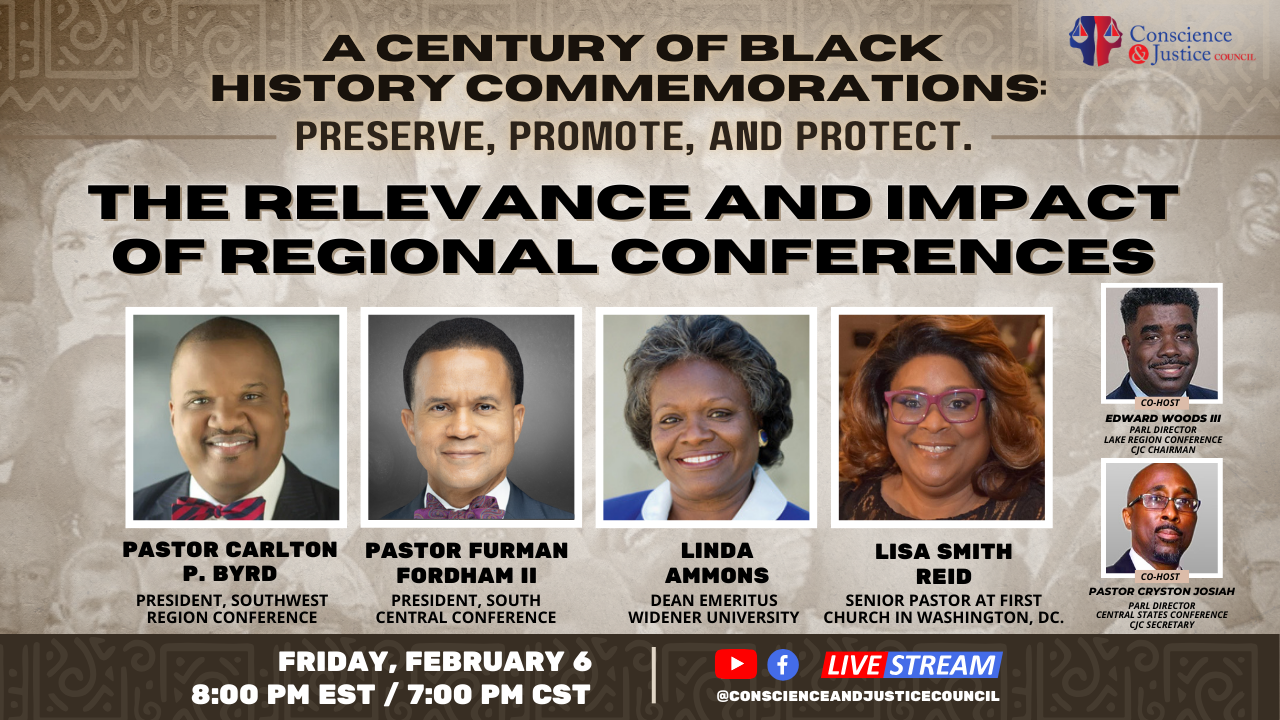
A Century of Black History Commemorations: Preserve, Promote, and Protect
On February 6, leaders and scholars gathered virtually for a powerful discussion hosted by the Conscience & Justice Council exploring the continued relevance of regional conferences within the Seventh-day Adventist Church.
Panelists included Carlton P. Byrd, Furman Fordham II, Linda Ammons, and Lisa Smith Reid, with co-hosts Edward Woods III and Cryston Josiah guiding the conversation.
A Necessary Conversation
The evening opened with reflection on a racist social media post targeting Barack Obama and Michelle Obama—a reminder that racism remains present in the public sphere. Panelists expressed outrage, but also emphasized that such incidents underscore why Black History Month discussions remain vital.
Why Regional Conferences Still Matter
The central question—Are regional conferences still relevant?—was answered with clarity: yes.
Panelists affirmed that regional conferences were created in response to racism, segregation, and exclusion within the church. Because those challenges have not fully disappeared, the structures designed to protect and empower Black Adventists remain necessary.
They highlighted several key reasons:
-
Mission effectiveness: People respond more openly to leaders who understand their culture. Regional conferences excel in urban and multicultural ministry.
-
Leadership development: They create pathways for Black leadership, representation, and decision-making.
-
Urban commitment: Regional conferences maintain a strong presence in inner cities and remain deeply engaged in community uplift and social justice.
Integration vs. Assimilation
A clear distinction was made between integration—shared power and mutual respect—and assimilation, where minority voices are absorbed into dominant culture. Regional conferences help preserve cultural identity, worship expression, and dignity.
Historically Justified. Missionally Necessary.
The discussion also revisited the history of enforced segregation within the church, reinforcing that regional conferences were not created out of preference for separation, but as a response to discrimination.
The panel concluded with a unified message: regional conferences are effective, biblically defensible, and still essential.
More than a century later, they continue to preserve, promote, and protect while advancing the gospel with purpose and power.