A Black History Month Reflection on Power, Prophecy, and the Kingdom of God
by Dr. J. A. O’Rourke, DMin
“Between the Christianity of this land and the Christianity of Christ, I recognize the widest possible difference — so wide, that to receive the one as good, pure, and holy, is of necessity to reject the other as bad, corrupt, and wicked.” — Frederick Douglass, Narrative of the Life of Frederick Douglass, an American Slave
Every February, the nation pauses to remember Black history. We celebrate courage. We retell survival. We honor ancestors who endured what should have killed them. Yet we do so inside a strange contradiction. The same country that enslaved our foreparents still insists on calling itself a Christian nation. For many of us, that phrase does not sound holy. It sounds haunted. It does not sound like good news. It sounds like chains clanking in a church basement.
Black people did not first encounter Christianity as freedom. We encountered it on ships. The gospel came to us in the mouths of men who carried Bibles and whips in the same hands. Enslavers quoted Paul while breaking families. Preachers baptized on Sunday and auctioned human beings on Monday. Plantation religion taught, “Servants, obey your masters,” but rarely, “Let my people go.” The cross was preached, but not the Exodus. Heaven was promised, but not dignity. If this was a Christian nation, it was a Christianity that worked very well for Pharaoh.
The claim collapses under even light historical scrutiny. The Constitution of the United States never names Jesus Christ, and the First Amendment explicitly forbids the establishment of a national religion. Yet while the state refused to establish Christianity officially, it quietly sanctified something else. It established whiteness as sacred and then baptized it. Whiteness became ownership. Blackness became property. One was granted dominion; the other was reduced to merchandise. One inherited rights; the other was inherited. One held the power to name and claim; the other could be named, claimed, sold, and erased. This was not merely social prejudice. It was a legal theology of domination wrapped in Christian language. Christianity was recruited as chaplain to the system, blessing slave codes, segregation, and silence, calling cruelty “order” and delay “prudence.” For Black Americans, the phrase Christian nation has rarely meant protection. It has meant surveillance, control, and the constant reminder to know one’s place.
This history produced two Christianities living side by side. One blessed the empire. The other survived it. One preached order. The other preached Exodus. One built cathedrals. The other sang spirituals in the dark. The enslaved did not receive Christianity as a tool of control; they reinterpreted it as resistance. They found Moses. They found the prophets. They found Jesus—lynched by the state and executed outside the city. They recognized Him immediately, not as Caesar but as kin. The Black church did not believe God was on the side of the powerful, because history had already proved He was not.
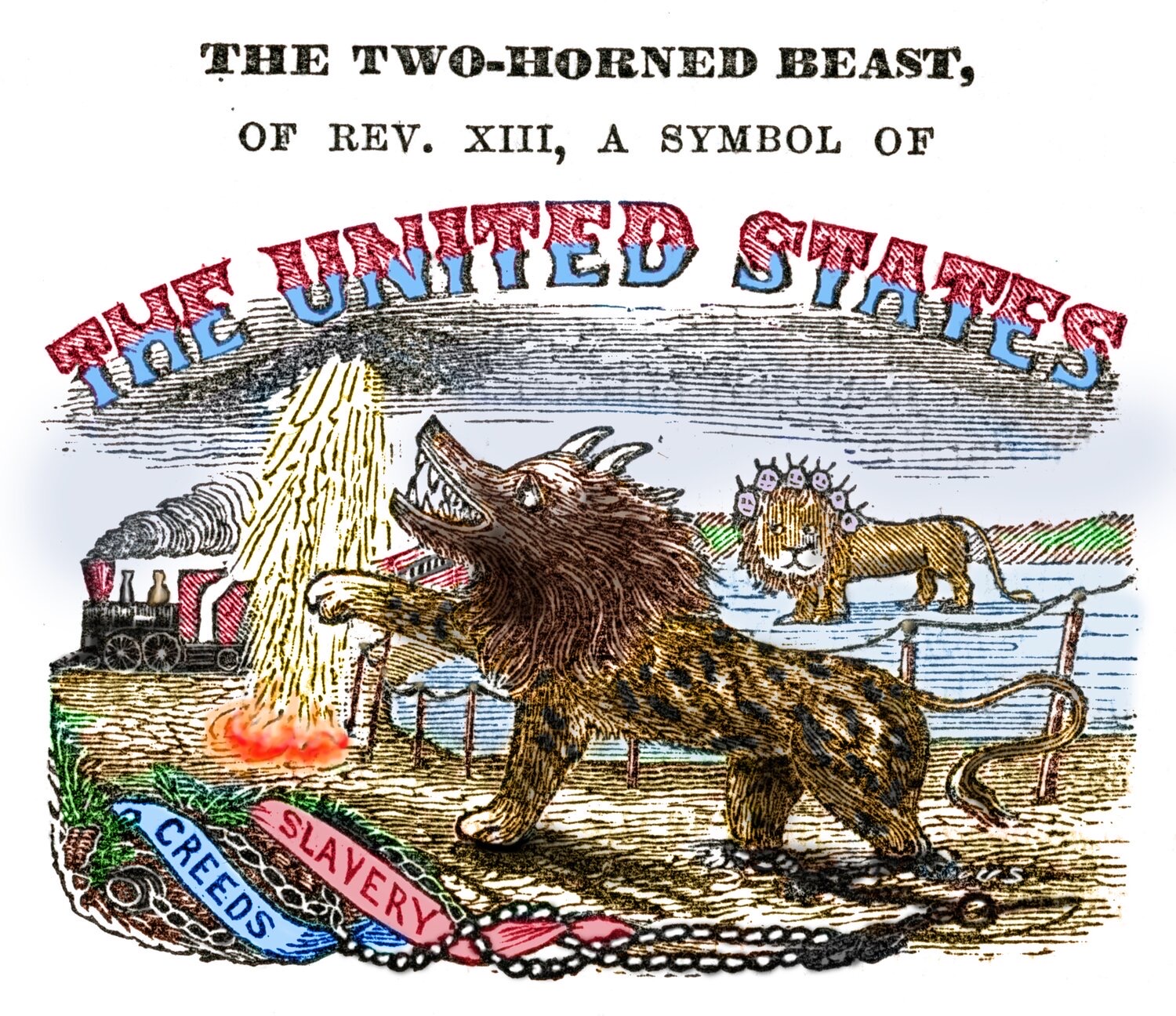
There is, however, an uncomfortable truth that those of us shaped by Adventism must also face. We have sometimes helped soften the lie. For more than a century, our Revelation seminars have described the second beast of Revelation as having “horns like a lamb,” and we have allowed that phrase to suggest innocence, gentleness, even nobility. The image became domesticated. The beast turned into something majestic and harmless. But early Adventists did not draw a lamb. They drew a wild boar. They understood something we have forgotten: the text never says the beast is a lamb. It only looks like one. Its gentleness is an appearance, not a character. The boar was the better symbol. Boars burrow up from the earth. They cannot be domesticated. They are fierce, proud, and destructive. When a herd moves across farmland, nothing survives their appetite. Crops, roots, fences, and habitats are torn up without discrimination. Farmers who live in harmony with the soil dread their approach because devastation follows their hunger. Boars do not negotiate with the field. They devour it. And if you want to trap them, you do not chase them; you bait them. Appetite and greed do the rest.
The metaphor is painfully precise. This nation rose from the earth of a “new world” and then moved westward devouring land and life. Native peoples were displaced. Treaties were broken. ecosystems erased. It spoke liberty while practicing removal. It preached democracy while dropping bombs. It quoted Scripture while protecting profit. It marketed freedom while consuming the world’s resources at unsustainable rates. It talks peace with its mouth while breaking promises with its hands. It appears lamblike, yet history records the voice of a dragon.
Perhaps most tragically, we baptized this behavior. We mistook prosperity for righteousness, dominance for divine favor, and empire for testimony. We wrapped the cross in a flag and called it faithfulness.
Even our present nationally behavior is boarish. Within the first year of this administration, roughly 229 executive orders have enacted regulatory, budgetary, and administrative changes consistent with many of the priorities outlined in Project 2025. Racialized and frequently force-based enforcement actions have pressured or compelled the departure of nearly 2 million immigrants—through both formal deportations and voluntary departures—as intensified interior sweeps and courthouse arrests often sidestep the very due-process protections the law is meant to guarantee. Immigrants, both authorized and unauthorized, contribute an estimated two trillion dollars annually to the American economy; the removal of roughly 2 million individuals therefore corresponds to an approximate fifteen to twenty billion dollars inlost annual economic output. At the same time, increased tariffs on imported goods have added roughly one hundred fifty-nine billion dollars in higher consumer costs, amounting to about twelve hundred dollars more per household each year. The numbers tell a sobering story: the very people portrayed as burdens are, in fact, sustaining the nation’s prosperity.
In contrast, the kingdom revealed in Jesus moves by an altogether different spirit. It does not claw its way upward through force but descends as gift and grace. It does not survive by consuming others but flourishes by giving itself away. Jesus touches lepers, feeds the hungry, forgives enemies, restores women, dignifies children, and calls strangers friends. His authority is secured not through violence but through love; His throne is established not by swords but by sacrifice. He refuses domination and chooses service, refuses retaliation and practices mercy, refuses fear and teaches forgiveness. He lays down His life rather than taking another’s. In Him, strength looks like gentleness, greatness looks like servanthood, and victory looks like a cross.
The first-century church carried this same life into the world. In Acts they shared their possessions, broke bread across class lines, welcomed foreigners, cared for widows, endured persecution without revolt, and overcame empire not by seizing Rome but by forming a community so just, so generous, and so Spirit-filled that no one among them lacked anything.
This is how Christ reigns—not through extraction but restoration, not through coercion but communion, not through the machinery of the state but through the transformation of the human heart.
So perhaps the question is not whether this country is a Christian nation. History has already answered that. The deeper question is which kingdom we will mirror. Black history reminds us that survival has never come from empire. It has come from faith, community, stubborn hope, and love that refuses to die. We were never saved by the nation. We were saved by Christ. And that difference has always been our freedom.